LA TRUITE ET L’AQUACULTURE
La truite, Oncorhynchus mykiss, appartient à la famille des salmonidés. Dans la nature, c’est un poisson carnivore, rusé et très exigeant : elle vit en eaux vives, fraîches (inférieures à 18°C) et riches en oxygène ; elle fuit la pollution.
La truite arc-en-ciel est originaire du versant pacifique de l'Amérique du Nord et fut importée en Europe dès 1880. C’est aujourd’hui la plus répandue en France.
La robe est parsemée de nombreux points noirs étoilés ; l’adulte possède sur les flancs une bande rosée à reflets irisés, particulièrement apparente chez les mâles à l’époque de la reproduction.
C’est au moyen âge que la technique de l’élevage des poissons d’eau douce s’est développée en France grâce aux moines.
Ce savoir-faire était déjà connu des Chinois, des Egyptiens et des Romains.
Ce n’est que vers la fin du XIXe siècle en 1866 que la salmoniculture a véritablement pris son essor grâce à deux pêcheurs vosgiens Messieurs Remy et Gehin qui mirent au point la reproduction artificielle des truites.
La truite arc-en-ciel est originaire du versant pacifique de l'Amérique du Nord et fut importée en Europe dès 1880. C’est aujourd’hui la plus répandue en France.
La robe est parsemée de nombreux points noirs étoilés ; l’adulte possède sur les flancs une bande rosée à reflets irisés, particulièrement apparente chez les mâles à l’époque de la reproduction.
C’est au moyen âge que la technique de l’élevage des poissons d’eau douce s’est développée en France grâce aux moines.
Ce savoir-faire était déjà connu des Chinois, des Egyptiens et des Romains.
Ce n’est que vers la fin du XIXe siècle en 1866 que la salmoniculture a véritablement pris son essor grâce à deux pêcheurs vosgiens Messieurs Remy et Gehin qui mirent au point la reproduction artificielle des truites.
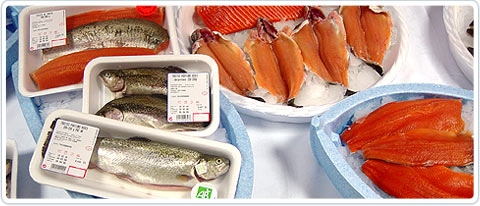
La France est un des premiers producteurs mondiaux de truites avec l’Italie et le Danemark, pour une production annuelle de 42 000 tonnes.
La truite se place au 6ème rang des poissons frais achetés par les ménages
Caractéristiques nutritionnelles générales de la truite
- Riche en protéines et en acides gras essentiels, peu calorique (environ 137 kcal/100 g de truite cuite), la truite est un aliment qui associe gastronomie et équilibre alimentaire.
Les protéines de la truite se distinguent de celles des animaux terrestres par une plus forte teneur relative en protéines solubles. Elles contiennent tous les acides aminés essentiels dont le corps a besoin, et sont extrêmement bien assimilées par notre organisme (75 % des protéines ingérées sont assimilées).
- La truite a une faible teneur en matière grasse : 100 grammes de chair de truite, cuite au four, apportent seulement 5g de matières grasses (source CIQUAL).
La teneur en magnésium de la truite est importante, ainsi que la teneur en potassium, l’apport en fer est intéressant. Ce qui fait de la truite un poisson riche en minéraux.
La teneur en cholestérol est plus faible que pour les autres poissons et l’apport en sodium est particulièrement bas.